
Plagued by Snakes
My family moved just as the pandemic kicked off this year. Into a house with snakes.
At first it was just a snakeskin in the attic. Then one in a crawlspace.
As spring sprung, we repeatedly caught a 4-footer trying to sneak in the back door. Then we saw a baby slithering across the playroom in the basement.
In the middle of the day we found this 4-footer meandering across the living room. That, and the heart-stopper of finding another 4-footer and a 5-footer trapped together in some garden netting, was a breaking point.
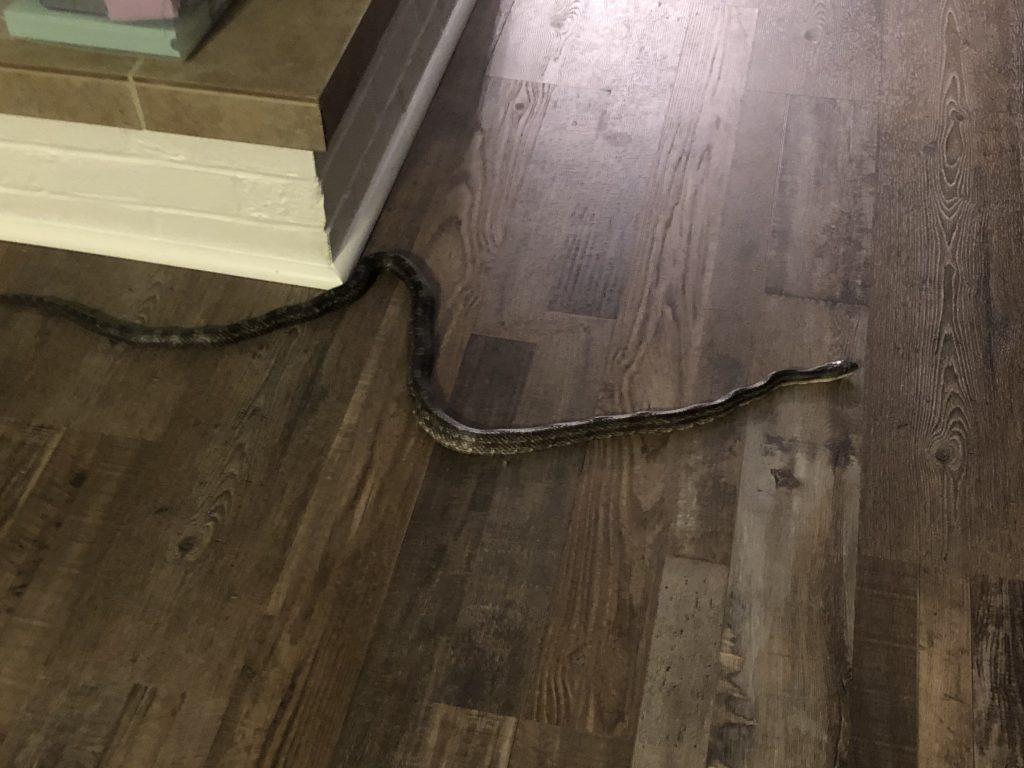
I’ll spare you more details and more encounters. But I learned three things:
- When you say out loud, “Well, we found a snake in the house,” some people will never visit you. Ever again.
- Whenever a snake surprised me, I had a gut reaction: I HATE YOU-SOMEBODY GET ME A STICK-RED ALERT-THIS THING MUST NOT BE. The poor guys weren’t even venomous.
- Gut reactions eventually give way to tedium. You are just waiting for things to get better. For somebody to fix your problem.
In my house, we celebrate the first Sunday in Advent by lighting the candle of Expectation. As we begin a countdown of four Sundays to Christmas, it is a good day to think about snakes and waiting.
And work.
Searching for Meaning
Eve didn’t yet have my gut reaction to snakes. But they really have been causing frustration since the beginning.
Instead of wanting to kill the snake, she listened as it told her lies: God was against her; the consequences of disobedience were overblown; she could be her own god.
She and Adam bought the lies, revolting against God’s plan. It turns out God’s warning about disobedience was not overblown: We were separated from God’s presence. Childbirth has become extremely painful. Relationships now have dimensions of conflict and striving. Work—whatever it is we do to put food on the table—takes sweat.
Not good, “in the zone” sweat. Just lots of effort and pain, all the days of our lives.
And then, no longer living directly in God’s presence, we die.
I wonder how long it took before all the pain Adam and Eve went through to survive felt tedious, even meaningless.
The ancient Greeks had a colorful example of this: Sisyphus was cursed for eternity with a job: Take a huge boulder up a hill. Watch it roll back down. Repeat. Forever.

Every time I share that myth in the workplace, I get a knowing chuckle or groan.
It seems like 2020 is the year of Sisyphus: Yet another masking-up. Another Zoom call. Another struggle with balancing work and home. More energy depleted being “on” for those around us. Then do it all over again.
I’ve sat with clients and friends this year fighting suicidal thoughts, PTSD, addictions and grief. World weary.
Do you know what are the two most common complaints I hear from teens in the Sunday school class I teach? “I’m bored.” And, “I’m anxious.”
Even our youth feel the pain and tedium of life. I am no longer tempted to say, “There there, it’s not so bad.” Instead I invite them to stare into the abyss and acknowledge that there must be more to life than this.
Waiting on God
The good news is that, in the middle of God spelling out the painful and tedious consequences to Adam and Eve, the Eden narrative records God blessing humanity with a promise. To the snake he says:
I will put enmity between you and the woman,
and between your offspring and her offspring;
he shall bruise your head,
and you shall bruise his heel.
Genesis 3:15
Scholars call it the protoevangelium, the “first good news.” (Why “bruise” is the verb, I don’t understand–I just know I now have a gut reaction of enmity to snakes!) God promised, right at the start, that he was going to send someone to make all this right.
His prophets later called this someone Messiah, “the Anointed One.”
They waited literally thousands of years for him to come.
Invasions. Family drama. Civil war. Moral decay in society. Personal decay and vices. Through all the pain and heartache, for generations, God’s people would be tempted to give up.
But during the Roman occupation of Palestine, they witnessed the protoevangelium fulfilled.
Correction: start to be fulfilled.
This is the part that makes it all so fascinating: God did not send a conquering celestial king to take over. He didn’t snap his fingers and fix it.
He sent himself as a human. He experienced all of life’s pain, conflict, sweat, frustrations—even the lies of that old serpent. Even tedious waiting. He experienced it all, from birth to death.
And after Messiah’s death, he had the audacity to announce that he was going away and would come back!
God’s people waited, expectantly, for Messiah to come. We now also wait, expectantly, for him to come back.
Or at least we have that option.
Waiting on God, Again
What if the pain and tedium of this year is a gift?
What if God is getting through to you and me that there is eternal meaning beyond our temporal circumstances?
What if he wants us to prepare our hearts just by waiting?
My prayer is that this Advent season becomes a time for you and I to get expectant. Not that our circumstances will magically improve, but that we see meaning beyond our circumstances.
I light the candle of Expectation today, waiting on God’s promises to be ultimately fulfilled. God is at work, even if it doesn’t look like it. Even when there are snakes.
Come back next Sunday for the second candle of Advent, Hope.